

Like most financial planning topics, you likely have come across various rules of thumb for retirement planning. Indeed some of the best practices can be no brainers like contributing to your 401(k) in order to take full advantage of any free money with an employer contribution match. However, there are aspects of retirement planning where it is not so clear cut. A great example of this is comes with choosing between Roth (after-tax) and traditional (pre-tax) retirement accounts. This decision significantly impacts your tax planning, both now and in the future.
Before diving in, this article is in no way intended to be tax advice. Instead the intent here is to offer a high level understanding of this retirement planning strategy topic. For the purpose of this discussion, I am writing it from the perspective of someone who is eligible to contribute to any type of retirement account. Please always consult with a tax professional to determine your specific eligibility for contributing to different types of retirement accounts.
Roth Vs. Traditional Accounts: Key Differences
| Roth (After-tax) Accounts | Traditional (Pre-tax) Accounts | |
| Contributions | No immediate tax benefit | Reduce current tax liability |
| Investment Growth | Tax-free growth | Tax-deferred growth |
| Withdrawals (after age 59½ subject to 5 year rule) | Tax-free | Taxed as ordinary income |
| Early Withdrawals (before age 59½) | Contributions tax-free; earnings taxed & penalized* | Both contributions and earnings taxed & penalized** |
* Exceptions to tax and penalty exist for Roth withdrawals, like a $10k withdrawal for a first-time home purchase.
** Pre-tax withdrawals are always taxable; exceptions for the Pre-tax withdrawal penalty exist similar to Roth.
The Roth vs. Pre-tax Decision: Key Factors
Future Tax Rates: Will tax rates be higher or lower when you retire?
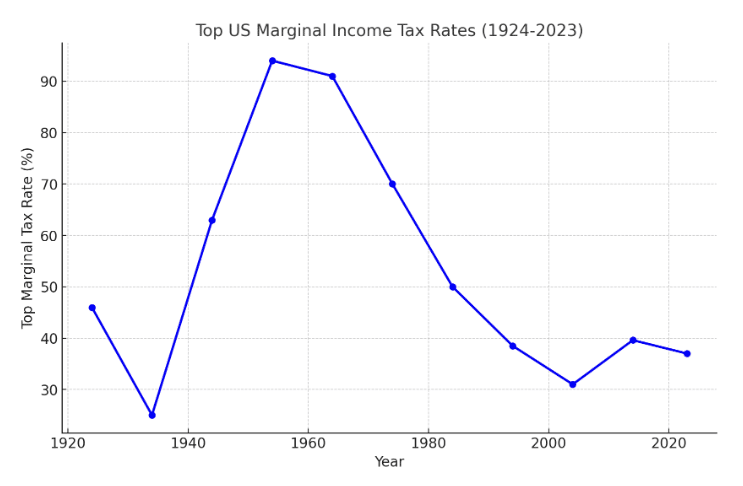
Today’s top marginal tax rate is 37%, lower than the 53% historical average over the last 100 years. Given the $1.7 trillion U.S. budget deficit, it’s possible that tax rates could rise over the next 20-30 years. If you believe tax rates will increase, a Roth account’s tax-free withdrawals might be more appealing.
Your Future Income: Will you earn more or less in retirement compared to today?
Peak earning years typically occur between ages 45-54. If you’re earning $200k-$300k today, you’re likely in a 22%-32% tax bracket. If you expect lower income and tax rates in retirement, traditional contributions may help reduce your current tax burden and lower taxes on future withdrawals.
Crafting Your Contribution Strategy
To simplify arriving at a conclusion of what makes most sense for your situation, we can boil down the decision to a few key criteria:
Choose Roth if:
You expect to be in a higher tax bracket in retirement (either because of your income increasing or overall tax rates increasing).
You want tax-free withdrawals and have a long time horizon for your investments to grow.
You value tax certainty and flexibility in retirement.
Choose Pre-tax if:
You expect to be in a lower tax bracket in retirement (either because you believe you are close to your peak earning years or you don’t expect overall tax rates to change a lot).
You want to reduce your taxable income today and invest your tax savings.
You are closer to retirement and value tax deferral over tax-free growth.
Finding Balance: Tax Diversification
It is quite understandable if you find it difficult to confidently predict if you will be in a higher or lower tax bracket in retirement given the assumption you’d have to make about your future income and US tax policy. I find that for most six figure earners who are close to their peak earnings years, especially those that live in states with high state income tax rates, the scale tips more towards making pre-tax contributions if the money you save in reducing your tax bill is instead invested and allowed to grow, compounding over time. This often results in higher overall wealth accumulation at retirement compared to making Roth contributions where you don’t get the upfront tax savings and the benefit from the compounding of investing those tax savings.
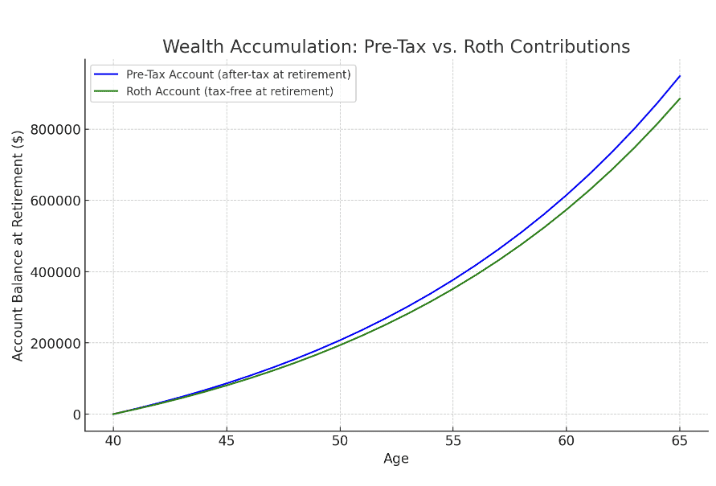
Even the though the odds on winner may be prioritizing pre-tax contributions, that does not mean there is no value in directing a portion of your retirement contributions to Roth accounts. Having a mix of pre-tax and Roth accounts can provide tax diversification benefits where the Roth accounts offer a hedge against future tax rate increases (or unexpectedly having higher income in retirement than today) as well as some flexibility in retirement to manage your tax liability by choosing which type of account to withdraw from. As a bonus, because there are no Required Minimum Distributions (RMDs) with a Roth IRA they can be advantageous for passing on tax-free wealth to your heirs. A Roth 401(k) does have to make RMDs starting at age 73 like traditional accounts, but this can be avoided if the account is rolled into a Roth IRA before the RMD age.
Bottomline:
In summary, a well-rounded retirement strategy may include both Roth and pre-tax contributions, allowing you to take advantage of today’s tax benefits while also preparing for an uncertain tax future. By planning ahead, you ensure more control over your financial future and retirement security.
Disclaimer: All written content is for informational purposes only. None of the information provided is intended as investment, tax, accounting, or legal advice, as an offer or solicitation of an offer to buy or sell, or as an endorsement of any company, security, fund, or other securities or non-securities offering. All information provided should be discussed with a registered advisor, accountant, or legal counsel prior to implementation. Opinions expressed herein are solely those of Sheer Empowerment Financial LLC (“SEF”), unless otherwise specifically cited. Presented material is believed to be from reliable sources and no representations are made by our firm as to another parties’ information accuracy or completeness.