

Making the leap from a W-2 job as an employee to self-employment is exciting, but it comes with a major challenge: figuring out how much income you need to replace not just your salary, but the total compensation package your employer provided. When you’re self-employed, it’s up to you to cover the costs and tax advantages that were once bundled into your benefits. So, how do you accurately estimate what you need to earn when you switch to self-employment to maintain your lifestyle?
Here’s a step-by-step example of what this could look like to give you a sense of how to estimate what you’ll need to earn as a self-employed individual to replace your entire employee compensation package:
1. Start with Your Current Salary
Your gross salary is the easiest place to start. Let’s say you’re making $150,000 per year, that’s your baseline income target.
2. Factor in the Tax Difference
As a W-2 employee, you only pay 7.65% of your income toward Social Security and Medicare taxes (the FICA tax), because your employer covers the other 7.65%. When you’re self-employed, you’re responsible for the entire 15.3% which is referred to as the self-employment tax. This additional 7.65% needs to be included in your income target.
Example:
On a $150,000 salary:
As a W-2 employee, you’d pay $11,475 in FICA taxes.
As a self-employed individual, you’ll pay $22,950 in self-employment tax.
The difference is an extra $11,475 in taxes that you’ll need to cover.
3. Health Insurance: Employer Plan vs. Marketplace
When transitioning from a W-2 employee to self-employment, one significant factor to consider is the cost of health insurance.
Employer-Sponsored Health Insurance:
Premiums: For example, for a W-2 employee in New Hampshire, your contribution for a family plan can average about $7,200 annually.
Marketplace Gold Plan:
Premiums: The average Gold plan premium for a 40 year old couple with two children in New Hampshire averages around $1,800 per month, totaling about $21,600 annually.
The difference is an extra $14,400 in health insurance premiums that you would need to cover.
Note: If your partner has employer provided health insurance, you and your children would be eligible to be added to their plan. You may also qualify for a premium tax credit through the Health Insurance Marketplace. If you do qualify, your actual costs may be significantly lower. Premiums and plan options also vary from state to state as well as based on your age and health needs. Finally, health insurance premiums paid by self-employed workers can be tax deductible.
4. Retirement Savings: The Lost Employer Match
One of the most significant benefits from a W-2 job is the employer’s contribution to your 401(k). Many employers match up to 5% of your salary. On a $150,000 salary, this match equals $7,500 per year. When you become self-employed, you’ll lose this “free money,” and you’ll need to factor that in to ensure you’re saving enough for retirement.
Note: To save for retirement when you are self-employed there are several options depending on your situation such as a Solo 401k, SEP IRA, SIMPLE IRA, Traditional IRA, and Roth IRA.
5. Flexible Spending Accounts (FSA): Tax Savings Benefit
As a W-2 employee, you may take advantage of flexible spending accounts for medical and dependent care expenses. FSAs allow you to set aside pre-tax dollars for medical and dependent care expenses, reducing your taxable income and lowering your tax bill.
Example:
Medical FSA: If you contribute $2,500 to a medical FSA, that amount is deducted from your taxable income. At a 24% marginal tax rate, this can save you $600 in taxes.
Dependent Care FSA: If you contribute $5,000 to a dependent care FSA for expenses like day care and after school programs, this also lowers your taxable income. At the same 24% marginal tax rate, you would save another $1,200 in taxes.
Total Tax Savings from FSA Contributions:
Medical FSA: $600
Dependent Care FSA: $1,200
Total Savings: $1,800
As a self-employed individual, you won’t have access to these pre-tax benefits. This means you’ll need to account for this $1,800 in lost tax savings when determining your income needs.
6. Paid Time Off: Vacation and Sick Days
In most W-2 jobs, you get paid time off for vacations and sick leave. When you’re self-employed, time off means no income. If you currently have 15 vacation days and 5 sick days per year, that’s 20 days total, or about 8% of your work year. You’ll need to increase your income by that amount to cover unpaid time off.
Quick calculation:
On a $150,000 salary, taking 20 days off means your employer previously paid you $12,000 for time that you weren’t not working.
7. Long-Term Disability Insurance
Many employers provide long-term disability insurance, which can replace around 60% of your income if you’re unable to work due to illness or injury. The cost of purchasing your own long-term disability insurance policy if you are 40 years old and in good health can range from 1% to 3% of your income.
Example:
On a $150,000 salary, you’d need to budget between $1,500 and $4,500 per year to replace your employer-provided disability insurance. For this calculation, let’s assume the mid-range cost of $3,000 annually.
Note: This range assumes the individual is in good health and selects a standard elimination period of 90 days. Factors like occupation, existing health conditions, and specific policy features (such as own-occupation coverage) can increase premiums.
8. Life Insurance: Two Times Salary
Employer-sponsored life insurance is another benefit you’ll need to replace. Typically, employers provide group life insurance coverage equal two times your annual salary. In this case, you’d have a policy worth $300,000. The average cost to purchase a 30 year term life insurance policy on your own is around $600.
Note: These rates also assume the individual is 40 years old and in good health, a non-smoker, and may vary depending on health conditions, the insurer, and specific underwriting criteria.
9. Add Business Expenses
Self-employment brings additional costs, such as accounting software, legal fees, office supplies, and marketing. Let’s estimate these expenses at $7,500 per year for a professional service business. If you were able to deduct all of these expenses from your taxable income, the net cost would be approximately $4,600.
Putting It All Together
Here’s a summary of the added costs you’ll need to consider when switching from a $150,000 W-2 job to self-employment:
- Tax Difference: $11,475
- Health Insurance Cost Difference: $15,600
- Lost Employer Match for Retirement Savings: $7,500
- Lost Tax Savings from FSA Contributions: $1,875
- Income for Paid Time Off: $12,000
- Long-Term Disability Insurance: $3,000
- Life Insurance Replacement: $600
- Business Expenses (With Tax Deduction): $4,600
Total Additional Income Needed: $56,650
+Current Base Salary: $150,000
=New Self-Employment Income Requirement: $206,650
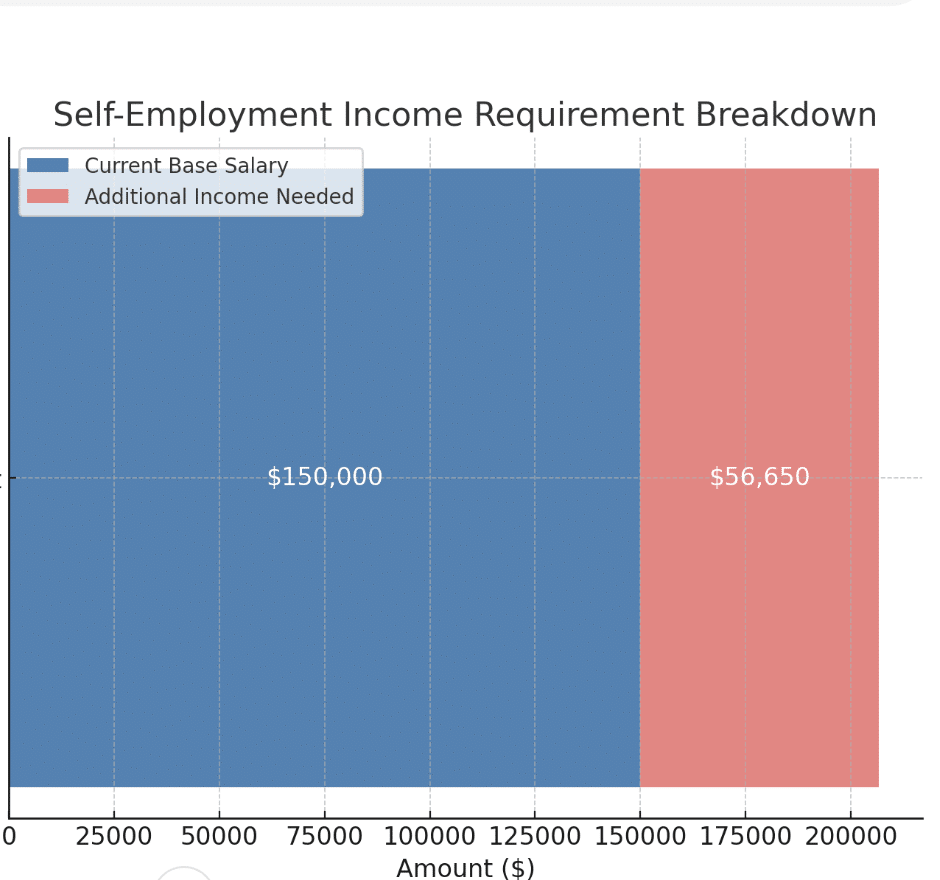
To maintain your lifestyle and replace all the benefits and tax savings provided by your W-2 job in this example, you would need to earn an extra $50k+ per year which equates to over $200,000 per year as a self-employed individual.
Important Considerations
This may make transitioning to self-employment seem financially daunting. However, it’s crucial to remember that building a successful business can take time. Depending on your industry and your marketing efforts, it may take several months—or even years—to reach this income target. You may need to start with a lower income and gradually grow your client base and revenue. Having a financial cushion (i.e. large emergency fund) or a part-time job can help ease the transition and provide stability as you work toward your income goals.
Final Thoughts
Switching to self-employment offers incredible freedom and flexibility, but it is key to account for the total compensation package when you leave your current job, including both benefits and tax savings. Carefully calculating these costs helps ensure you’re financially prepared to make the leap and thrive in your new venture.
Disclaimer: All written content is for informational purposes only. None of the information provided is intended as investment, tax, accounting, or legal advice, as an offer or solicitation of an offer to buy or sell, or as an endorsement of any company, security, fund, or other securities or non-securities offering. All information provided should be discussed with a registered advisor, accountant, or legal counsel prior to implementation. Opinions expressed herein are solely those of Sheer Empowerment Financial LLC (“SEF”), unless otherwise specifically cited. Presented material is believed to be from reliable sources and no representations are made by our firm as to another parties’ information accuracy or completeness.